Cameroon Imported Used Car Guide: Access, Taxes, and Customs Clearance (2026)
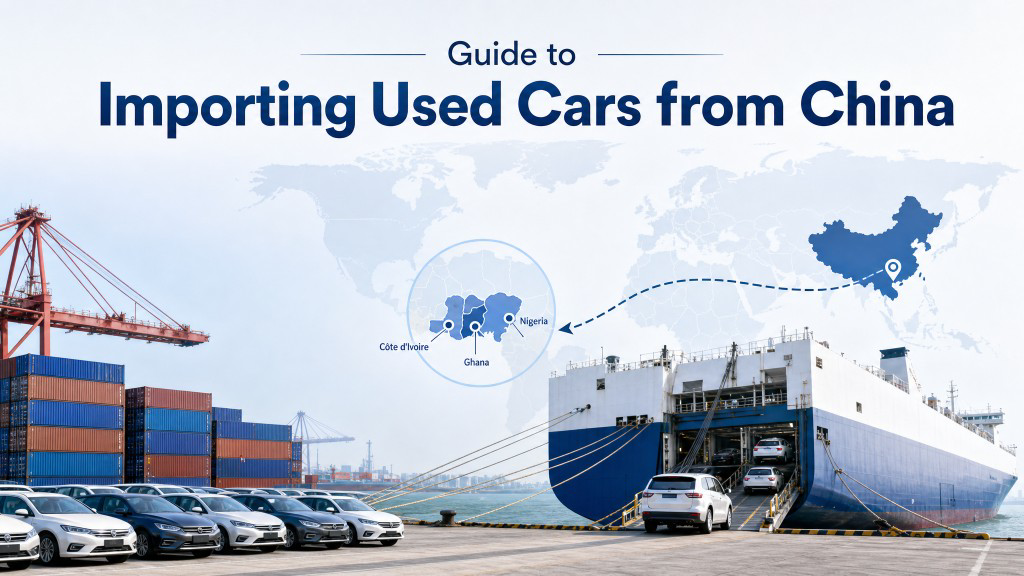
Cameroon’s used-car trade turns on Douala and Yaoundé. Vehicles arrive by sea at the Autonomous Port of Douala (PAD) or Kribi (PAK), then move into local wholesale yards and inland towns. Demand looks familiar across West Africa: Corolla-class sedans and RAV4-type SUVs lead retail volume; pickups and Hiace-class vans stay busy on logistics and passenger routes. On the supply side, European stock is easier to document and easier for buyers to trust; China-sourced left-hand-drive units win on price and model range, and their share in Douala yards keeps rising.
Cameroon sits in the CEMAC customs union. Unlike Nigeria or Ghana, there is no hard official age ban on used imports—but the old import procedure was scrapped in 2024, and 2026 added higher excise on older cars. For wholesale, two questions matter most: can you bring the car in at a cost that still works, and can you price the tax and clearance path without surprises? A lot of losses happen before the ship sails—when nobody checked the age band, the paperwork, or how the tax notice would stack.
Key takeaways
Public rules do not say “over X years = banned”—but cars aged 12–20 years attract 12.5% excise on CIF, and cars over 20 years attract 25%
Passenger cars commonly face about 30% customs duty and 19.25% VAT (usually on CIF + duty + excise and some surcharges); each unit also pays about XAF 29,813 for verification
Since 2024 the old one-stop PIVO process is gone; FOB above XAF 1,000,000 needs an Import Declaration filed by a licensed customs broker
European cars usually need the original registration card; China-sourced cars usually cannot provide one—confirm substitutes in writing before loading
Cameroon drives on the right—buy left-hand drive in bulk; clearance ≠ road-legal
Before any deposit: VIN, first-registration date, and document list → Douala licensed broker → pay only after a written reply
2026 at a glance


Topic | As of 2026-08-31 |
|---|---|
Age and excise | Under 12 years: usually no tiered age excise. 12–20 years: 12.5% (CIF). Over 20 years: 25% |
Customs duty | Passenger cars commonly about 30% (CIF); HS class can land roughly 5%–30% |
VAT (TVA) | 19.25% (usually on CIF + duty + excise and related add-ons) |
Vehicle verification | About XAF 29,813 per unit (tax-inclusive) |
Steering | Left-hand drive is the norm; right-hand drive is a poor bulk bet |
Import path | Import Declaration + licensed broker + BESC + CIVIC → CAMCIS clearance |
EU / China documents | Europe usually needs the original carte grise; China usually cannot provide one—confirm substitutes in writing |
Clearance ports | Douala and Kribi |
Clearance ≠ road-ready | Technical inspection → tax-compliance certificate → registration → compulsory insurance |
Before you order | VIN, first-registration date, document list → licensed broker in writing |
Procedures changed: PIVO is gone—Import Declaration comes first
The 2024 Finance Law permanently removed the PIVO one-stop flow that used to sit on e-FORCE. For vehicle imports with FOB above XAF 1,000,000, you now need an Import Declaration (Déclaration d'Importation) on e-GUCE / e-FORCE—and only a licensed customs broker can file it. Skip it, load the car anyway, and the official line is a fine of up to 50% of the dutiable value, plus no clearance.
Beyond the Import Declaration, each unit still needs an electronic cargo tracking note (BESC) and vehicle identification control (CIVIC)—about XAF 29,813 per car (tax-inclusive) since 1 July 2025. On the company side, you usually need listing on the Ministry of Commerce importer register and a tax ID (NIU and related numbers). Before you scale volume, have your broker check that your paperwork is in place.
Source: GUCE notice: PIVO abolished and what changes next (CM-GUCE-PIVO-2024)
How age is counted: no hard ban, but a cost ladder
Cameroon is not Senegal or Benin. GUCE’s public materials do not say “over X years = refused at the border.” The lever is excise: the older the car, the higher the rate on CIF. For wholesale, keep age under 12 years whenever you can.
Age runs from the first registration date (première immatriculation) to the expected discharge date—not model year, and not the day you bought the car second-hand.
Age (from first registration) | Excise | What it means for importers |
|---|---|---|
Under 12 years | No tiered age excise as above | Costs stay more manageable; some EU cars under 10 years may qualify for treaty preference |
12–20 years | 12.5% (CIF) | Still admissible, but the excise can wipe the margin |
Over 20 years | 25% (CIF) | Only rock-bottom purchase prices may work; most wholesale buyers should walk away |
Left-hand drive, model fit, and chassis checks before arrival
Cameroon drives on the right. Left-hand-drive stock from China, continental Europe, or the US fits the market; right-hand-drive units usually mean conversion headaches or registration trouble—skip them in bulk.
Before arrival, check the chassis number in the customs vehicle monitor COSMOS (portran.cm): has the unit already been cleared lawfully in Cameroon? That helps you avoid “cheap local” cars that never paid import tax. Pure electric and hybrids have recent talk of excise relief; accident and flood cars are not covered by a clear “import ban” chapter, but inspection at arrival is common—pull history before you load.
Documents: Europe and China diverge on the registration card
Invoice, bill of lading, insurance, BESC, Import Declaration—those barely change with origin. What stops clearance is usually whether you have the original registration card.
Document | Required? | Notes |
|---|---|---|
Commercial invoice | Yes | Price basis; VIN must match |
Ocean bill of lading | Yes | VIN, make, and model must appear |
Marine insurance | Yes | Needed to complete CIF |
Registration/title original (carte grise, etc.) | Depends on export country | Europe: original usually required. China: after deregistration, originals are usually unavailable |
Non-lien certificate (certificat de non-gage) | Common on European stock | Shows no loan, pledge, or seizure; not a Cameroon customs form. China-sourced cars need broker-approved substitutes |
Electronic cargo tracking note (BESC) | Yes | Issued on the national freight-forwarder side |
Import Declaration | Required when FOB exceeds XAF 1,000,000 | Filed in-system by a licensed broker |
Vehicle identification control (CIVIC) | Yes | About XAF 29,813 per unit (GUCE notice) |
Tax compliance certificate (ACF) | Often required for private importers from 2026 | Private import and registration use cases |
Tax ID (NIU, etc.) | Yes | Importer tax identity |
Importer register listing | Yes | Ministry of Commerce listing |
Certificate of origin | When a treaty applies | e.g. EU stock seeking preference |
Non-Chinese, non-French documents usually need a certified French translation. Before you wire money overseas, confirm with your bank which contracts and invoices they need.
Eight checks before you pay a deposit
# | Check | What to verify |
|---|---|---|
1 | VIN / chassis | Matches invoice and B/L; pre-check in COSMOS |
2 | First-registration date | Count forward to expected Douala or Kribi discharge; see if you hit the 12.5% / 25% excise bands |
3 | LHD / RHD | Bulk buys: left-hand drive only |
4 | Registration papers | Europe: insist on the original card; China: get written broker confirmation of substitutes |
5 | Full path with the broker | Import Declaration + BESC + CIVIC + clearance |
6 | Tax compliance / tax ID | Private importers: lock tax papers early |
7 | HS classification | Passenger vs commercial changes the duty band |
8 | Written confirmation | Send the list to a Douala licensed broker; deposit only after a written reply |
Petrol, hybrid, EV: where the rates differ
Powertrain | HS (examples) | Duty | Age-based excise | Notes |
|---|---|---|---|---|
Petrol / diesel passenger car | 8703.xx | Commonly ~30% | 12–20 years 12.5%; >20 years 25% | Most common |
Non-plug-in hybrid | 8703.40 etc. | Commonly ~30% | 12–20 years 12.5%; >20 years 25% | Do not claim EV excise relief |
Plug-in hybrid | 8703.60/70 | Commonly ~30% | 12–20 years 12.5%; >20 years 25% | Do not claim EV excise relief |
Battery electric | 8703.80 | Commonly ~30% | Excise relief may apply (2025 policy talk) | Confirm in writing with a licensed broker |
Light commercial truck | 8704.xx | Commonly ~10%–20% | Age bands broadly similar to passenger cars | Duty often lower than passenger cars |
For EU-origin cars under 10 years: under the 2019 EU Economic Partnership Agreement (EPA), qualifying units may enter duty-free. You need proof of origin and a licensed broker’s check—do not treat marketing claims as a blanket exemption.
How customs values the car
Most taxes sit on CIF: FOB goods value + marine insurance + ocean freight to Douala or Kribi. On arrival, a third-party inspector (often SGS) may check the unit and the valuation; used cars can also be assessed against a reference or minimum taxable value, not just your invoice price.
Before loading, send the invoice, specs, and first-registration details to a Douala licensed broker for a CIF pre-check. Arguing valuation after the ship docks is the expensive way to learn.
Which taxes apply—and how they stack
At customs (typical HS 8703 passenger-car structure)
Charge | Meaning | Rate | Usual base |
|---|---|---|---|
DD (Droits de Douane) | Customs duty | Commonly about 30% | CIF |
Accise | Excise (by age) | 12–20 years 12.5%; >20 years 25% | CIF |
TVA | VAT | 19.25% | CIF + duty + excise + some surcharges |
TCI and related | Community / statistical add-ons | About 1%–3% | Often CIF-scale (tax notice prevails) |
CIVIC | Import vehicle identification | About XAF 29,813 | Fixed per unit |
Final amounts come from the broker’s simulation and the customs tax notice (Avis de liquidation). The examples below are for order-of-magnitude only.
After clearance: money still due for registration
Technical inspection (contrôle technique), registration tax by class/engine size, the ACF often seen in private cases, and third-party liability insurance—none of that sits on the customs notice. Build it into wholesale quotes separately.
Landed-cost examples
Figures below cover government charges at customs + vehicle verification only. They exclude registration tax, port charges, broker fees, inspection fees, and insurance. FX example: USD 1 ≈ XAF 600 (use the rate on payment day).
Example 1: 8-year petrol sedan
Item | Amount |
|---|---|
FOB | USD 8,000 |
Freight + insurance | USD 1,400 |
CIF | USD 9,400 (about XAF 5,640,000) |
Duty 30%              = 5,640,000 × 30%      = 1,692,000 XAF
Excise                = 0 (under 12 years)
VAT base              = 5,640,000 + 1,692,000 = 7,332,000
VAT 19.25%            = 7,332,000 × 19.25%   ≈ 1,411,410
Add-ons (~2% illustrative) = 5,640,000 × 2%  ≈   112,800
CIVIC                 =                         29,813
────────────────────────────────────────────────
Customs-side total ≈ 3,246,023 XAF (about USD 5,410)
The add-on rate here is illustrative; whether VAT includes every surcharge depends on the tax notice.
Example 2: 15-year sedan (12.5% excise)
Item | Amount (XAF) |
|---|---|
CIF | 3,000,000 |
Duty 10% (sample rate, not fixed) | 300,000 |
Excise 12.5% | 375,000 |
VAT 19.25% | ~707,906 |
CIVIC | 29,813 |
Total | ~1,412,719 |
Clearance path: from Import Declaration to the road

Sea-borne vehicles clear mainly at the Autonomous Port of Douala (PAD) and the Autonomous Port of Kribi (PAK). A practical sequence:
Step | Stage | Notes |
|---|---|---|
1 | Pre-check the unit | Age, steering, documents (see checklist above) |
2 | Appoint a licensed broker (CDA) | Sign a power of attorney |
3 | File the Import Declaration (DI) | Usually required when FOB exceeds XAF 1,000,000 |
4 | Electronic cargo tracking note (BESC) | Link to the single-window reference |
5 | Vehicle identification (CIVIC) | Submit chassis number; pay about XAF 29,813 |
6 | Load and sail | China–Douala RoRo often about 35–50 days (schedule-dependent) |
7 | Declare in CAMCIS | Start after verification results are in |
8 | Arrival inspection + valuation | Third-party inspection is common |
9 | Pay and release | Broker pays; collect payment proof |
10 | Gate-out | Douala or Kribi |
11 | Inspection + tax papers + registration + insurance | Cleared is not the same as road-legal for resale |
Clearing without a prior Import Declaration: officials cite a fine of up to 50% of the dutiable value (see the GUCE notice).
Registration, insurance, and plates
Once you hold the clearance papers, you still register the car with the transport authorities. Core files are usually the customs tax notice, origin-country registration evidence, and—especially for private importers—the ACF. The local registration card is also called a carte grise, but it is not the European original.
European stock usually needs that original origin card; China-sourced stock usually has none—ask a Douala licensed broker for acceptable substitutes before you load. Compulsory insurance starts with third-party liability; without it you are not lawfully on the road.
Sources and references
Source | What it covers | Link / grade |
|---|---|---|
GUCE notice | PIVO abolished; Import Declaration via licensed broker; CIVIC fee; excise tiers | guichetunique.cm (Grade A) |
CEMAC Regulation 02/18 | FOB above XAF 1,000,000 needs a prior Import Declaration | Cited inside the GUCE notice (Grade A) |
COSMOS / portran.cm | Whether a chassis has already been lawfully cleared |
Disclaimer: This article is for reference only. Rates, procedures, and documents follow Cameroon Customs, the single window (GUCE), and the written reply/tax notice from your licensed broker. Get that confirmation before payment or loading.