Guide to Importing Used Cars from China
Many used-car traders in West Africa now source their vehicles from China. Compared with Japanese and European/American used vehicles, Chinese cars offer abundant supply and clear price advantages. They are uniformly left-hand drive, making them suitable for the vast majority of West African countries that drive on the right. This gives them advantages in both local retail and inland re-export. This article lays out a more practical step-by-step process, from vehicle selection, sourcing, shipping, and customs clearance to risk control, to help importers complete their first order more safely.
I. Why Import Used Cars from China?
For West African importers and wholesalers, the Chinese used car market has several clear advantages:
1. Strong price advantage and abundant supply: China has a complete automotive industry chain and a massive new and used car market. There is a rich inventory of domestic brands and joint-venture models, and bulk procurement costs are usually lower than comparable Japanese and European/American used cars, helping to improve profit margins.
2. No conversion needed — ready to drive: Vehicles in China are uniformly left-hand drive, and the vast majority of West African countries drive on the right. There is no need for additional steering wheel conversion, saving both cost and time, and reducing the risk of issues during annual inspection and registration.
3. Comprehensive model selection: There is a stable supply of fuel SUVs, pickup trucks, family sedans, and passenger vans. Domestic electric vehicles such as BYD, Geely, and Wuling are relatively affordable, making them suitable for short-distance urban commuting or fleet pilots.
4. Mature export logistics system: China has a well-established used car export industry and port logistics system, making it convenient for wholesalers to place small trial orders or full-container purchases.
II. Vehicle Selection Advice: What Cars Suit the West African Market?
Best-selling models in the West African market are mainly practical, durable, high-ground-clearance vehicles that are easy to maintain:
SUVs/Pickup Trucks: Toyota RAV4, Honda CR-V, Hyundai Tucson, Kia Sportage, Great Wall Poer, Nissan Navara, etc.
Compact Sedans/Hatchbacks: Toyota Corolla, Honda Civic, Hyundai Elantra, Kia K3, Geely Emgrand, Chery Arrizo, etc.
Vans/Commercial Vehicles: Used for passenger transport and logistics, such as Toyota Hiace, Jinbei, Foton, Wuling, etc.
Electric Vehicles: BYD Yuan Plus, Qin Plus, Wuling Hongguang MINI EV, etc., suitable for short-distance urban travel, but local charging conditions need to be considered.
Vehicle selection advice:
Prioritize brands with parts supply and maintenance network coverage in West Africa.
For the first cooperation, it is recommended to purchase 1–4 vehicles as a trial order to test customs clearance, logistics, and end-market response.
Pay attention to vehicle emission standards and age, as some West African countries have strict limits on used car age.
III. How to Find and Vet Chinese Suppliers?
Used-car exports from China must normally be handled by companies with the appropriate export qualifications.
Supplier vetting checklist:
Business license + used car export enterprise filing qualification
Ability to provide vehicle VIN, registration certificate, title certificate, and inspection reports
Do they have export experience to West Africa or other African countries?
Do they accept third-party inspection or live video vehicle viewing?
Does the quotation include vehicle transfer, export customs declaration, port fees, etc., to avoid hidden costs?
Recommended approach:
Look for Chinese automotive B2B export platforms with state-owned enterprise backing (such as UCCVIP.COM) or find suppliers at offline used car markets.
Be wary of quotes far below market price, especially transactions requiring payment to personal accounts.
IV. Vehicle Inspection and Export Compliance
Key inspection items:
Whether the vehicle has been in an accident, flooded, or burned
Whether the odometer reading is genuine and whether there are signs of rollback
Whether the engine, transmission, chassis, air conditioning, and electronic systems are functioning properly
Tires, brakes, lights, and other basic safety components
China export requirements:
The vehicle must be legally registered and must complete the transfer of registration before export.
The export company must obtain a used car export license and declare to customs.
The vehicle must pass a safety technical inspection, and some models must meet environmental requirements.
Electric vehicle batteries must be declared as dangerous goods as required.
V. Logistics and Shipping: From Chinese Ports to West Africa
Main Chinese loading ports: Tianjin, Shanghai, Ningbo, Guangzhou, Shenzhen, Qingdao.
Shipping methods:
RoRo (Roll-on/Roll-off): Lower cost, suitable for standard vehicle shipping.
Container: Suitable for high-value vehicles or electric vehicles, but more expensive. EV batteries must be declared as dangerous goods.
Shipping time: From major Chinese ports to West Africa typically takes 30–45 days, and booking in advance is required during peak season.
Insurance: It is recommended to purchase marine insurance to cover risks such as collision, fire, and theft during transit.
VI. Documentation Checklist
Usually provided by the Chinese exporter:
Commercial invoice, packing list, used car export license, vehicle registration certificate/title certificate, inspection report, bill of lading (original or telex release), and certificate of origin (if required by the destination country).
VII. Destination Port Customs Clearance and Taxes
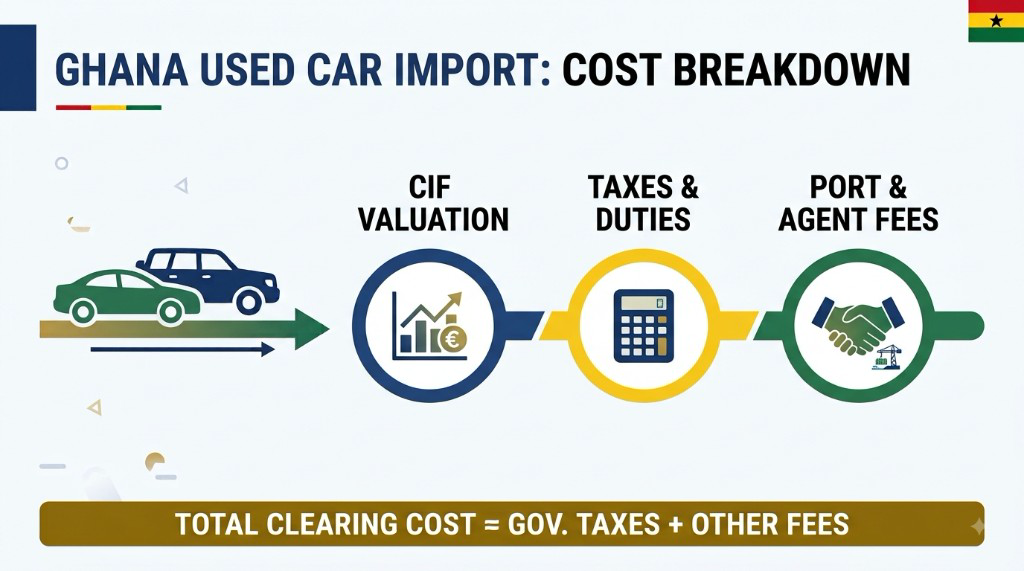
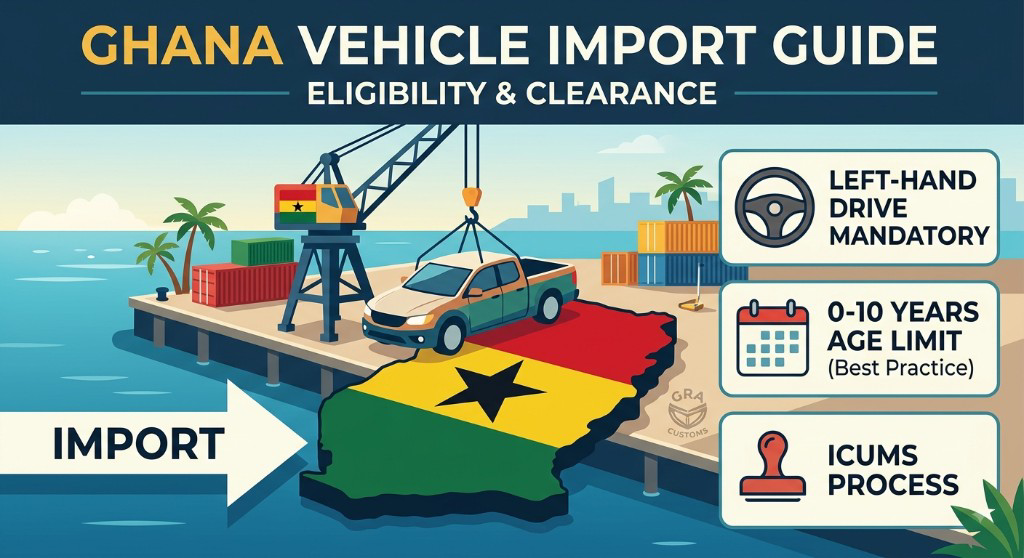
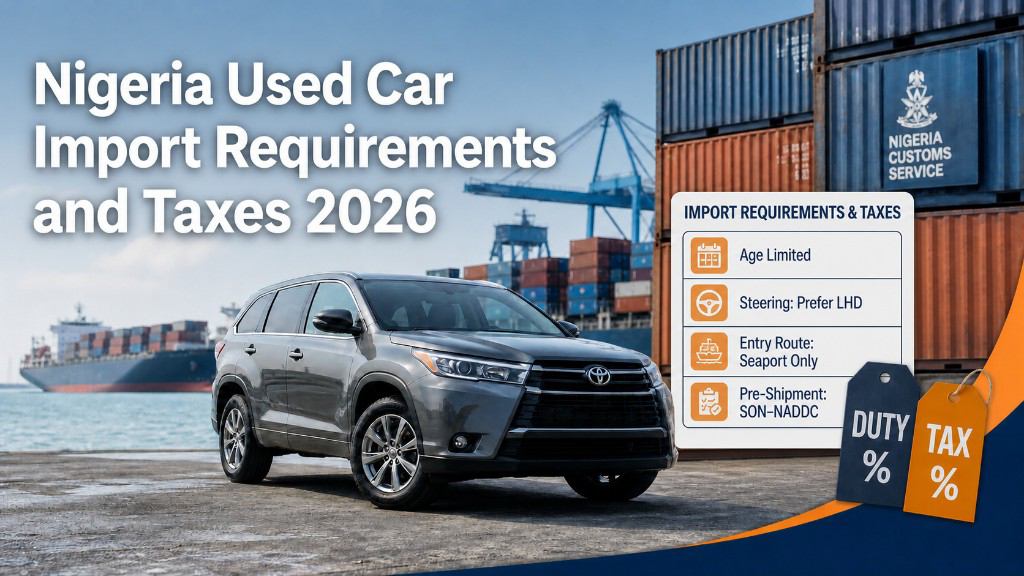
Customs duties, VAT, and import policies vary significantly across West African countries. Be sure to consult a licensed local customs broker before shipping to confirm the latest tax rates and vehicle age restrictions.
VIII. Risk Alerts and Operational Recommendations
1. Start with a small trial order
Do not make large purchases on the first cooperation. First test the supplier, logistics, and customs clearance process.
2. Pay close attention to actual vehicle condition
Be sure to use third-party inspection or video vehicle viewing to avoid accident-damaged, flooded, or odometer-rolled-back vehicles.
3. Confirm destination country policies
Age limits, emission standards, import licenses, and EV policies must all be clearly confirmed before purchasing.
4. Choose a reliable customs broker
Destination port clearance is a critical step in used car import. Choose an experienced and reputable broker.
5. Consider parts supply and after-sales service
Although Chinese brand used cars are low-priced, local parts supply and repair capabilities must be considered, otherwise end-customer acceptance will decline.
6. Keep complete documentation
Invoices, contracts, bills of lading, inspection reports, and other documents should be archived for future sales, claims, or re-export.
IX. How Can We Work Together?
We are a B2B vehicle export company focused on the West African market, providing one-stop services from vehicle sourcing, inspection, documentation, to shipping and customs clearance support.
If you are an importer or wholesaler in Nigeria, Ghana, or Côte d'Ivoire, feel free to contact us for:
Vehicle and price lists tailored to your market (fuel vehicles + new energy vehicles)
Landed cost estimates for bulk purchases (CIF Lagos/Tema/Abidjan)
Trial order and long-term supply plans
Conclusion
Importing used cars from China is a cost-controllable opportunity with attractive profit margins for West African importers and wholesalers. The key to success lies in: choosing the right models, controlling vehicle condition, calculating taxes accurately, clearing customs smoothly, and building stable channels. It is recommended to start with a reliable Chinese export platform or supplier, place a small trial order first, and then gradually expand procurement scale.