Ghana Used Car Import Taxes
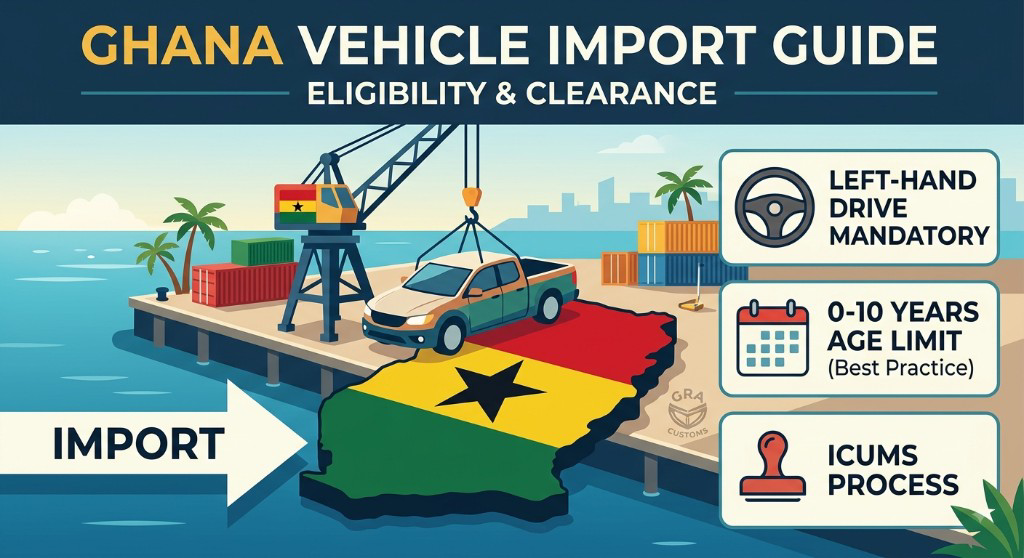
Ghana used car importers who import cars from China face more than standard import duty. Importers may also need to pay VAT, NHIL, GETFund Levy, AU Levy, ECOWAS Levy, EXIM Levy, examination fees, processing charges, port fees, and overage penalties for older used vehicles. The final tax amount usually depends on CIF value, fuel type, engine displacement, HS code, vehicle purpose, production year, and customs valuation.
I. Petrol and Diesel Car Duty Rates
Vehicle Type | Engine displacement | Import duty | VAT | NHIL | GETFund Levy | AU/ECOWAS/EXIM |
|---|---|---|---|---|---|---|
Petrol passenger car | Up to 1000cc | 5% | 12.5% | 2.5% | 2.5% | Approx. 1.45% |
Above 1000cc up to 3000cc | 10% | 12.5% | 2.5% | 2.5% | Approx. 1.45% | |
Above 3000cc | 20% | 12.5% | 2.5% | 2.5% | Approx. 1.45% | |
Diesel passenger car | Up to 1500cc | 5% | 12.5% | 2.5% | 2.5% | Approx. 1.45% |
Above 1500cc up to 2500cc | 10% | 12.5% | 2.5% | 2.5% | Approx. 1.45% | |
Above 2500cc | 20% | 12.5% | 2.5% | 2.5% | Approx. 1.45% |
II. Common Taxes and Tax Bases
Tax type | Common rate | Tax base |
|---|---|---|
VAT | 12.50% | CIF + Duty + NHIL + GETFund |
NHIL | 2.50% | Subject to customs regulations |
GETFund Levy | 2.50% | Subject to customs regulations |
AU Levy | 0.20% | 按 CIF |
ECOWAS Levy | 0.50% | 按 CIF |
EXIM Levy | 0.75% | 按 CIF |
Examination Fee | 1% | 按 CIF |
Special Import Levy | 2% | 按 CIF |
III. Overage Penalties for Used Vehicles
Vehicle age | Possible treatment | Indicative penalty |
|---|---|---|
Up to 10 years | Normal importation | 0% |
More than 10 up to 12 years | Mild overage | Approx. 5% or higher |
More than 12 up to 15 years | Moderate overage | Approx. 20% or higher |
More than 15 up to 25 years | Severe overage | Approx. 50% or higher |
More than 25 years | Very old vehicle | May reach approx. 70% or higher |
*These figures are budgeting references. The actual charge depends on vehicle type, production year, customs valuation, HS classification, and ICUMS assessment. | ||
IV. Battery Electric Vehicle Policy
Battery electric vehicles are generally reviewed under HS Code 8703.80. Qualifying BEVs may benefit from import-duty relief or exemption, but importers should verify the current policy and ICUMS treatment before shipment.
Charge items | Possible treatment |
Import duty | May be 0% if the vehicle qualifies |
VAT, NHIL and GETFund Levy | Verify under current policy and ICUMS |
AU, ECOWAS and EXIM levies | Confirm whether applicable |
Port and processing fees | Usually budgeted separately |
V. Hybrid Vehicle Treatment
HEVs and PHEVs contain internal-combustion engines and cannot automatically be treated as fully electric vehicles.
Vehicle type | Internal-combustion engine | Main assessment factors |
|---|---|---|
BEV | No | HS code and EV policy |
HEV | Yes | Engine displacement and HS code |
PHEV | Yes | Engine displacement, classification and policy |
Range-extended EV | Usually yes | Powertrain structure and HS code |
VI. Calculation Example
Assume a petrol passenger car has a CIF value of USD 20000, a 1500cc engine and a 10% import-duty rate.
This simplified example excludes overage penalties, examination fees, processing fees, special import taxes, port charges and exchange-rate changes.
Item | Calculation | Example amount |
|---|---|---|
CIF value | — | USD 20,000 |
Import duty | 20,000 × 10% | USD 2,000 |
NHIL | 20,000 × 2.5% | USD 500 |
GETFund Levy | 20,000 × 2.5% | USD 500 |
VAT base | 20,000 + 2,000 + 500 + 500 | USD 23,000 |
VAT | 23,000 × 12.5% | USD 2,875 |
AU, ECOWAS and EXIM | 20,000 × 1.45% | USD 290 |
Illustrative tax total | — | USD 6,165 |
VII. Pre-Shipment Checklist
Confirm the vehicle brand, model, trim and specifications
Confirm production year and manufacturing date
Confirm the petrol, diesel, BEV or hybrid powertrain
Confirm engine displacement or electric-drive specifications
Confirm seating capacity and intended use
Confirm HS code and CIF value
Check for any overage penalty
Verify eligibility for EV or other import incentives
Use the ICUMS vehicle calculator for an estimate
Obtain final confirmation from a licensed Ghanaian clearing agent
Conclusion
Ghana vehicle importers must consider engine displacement, fuel type, CIF value, vehicle age, HS classification, and policy incentives.