senegal-used-car-import-taxes-clearance-2026
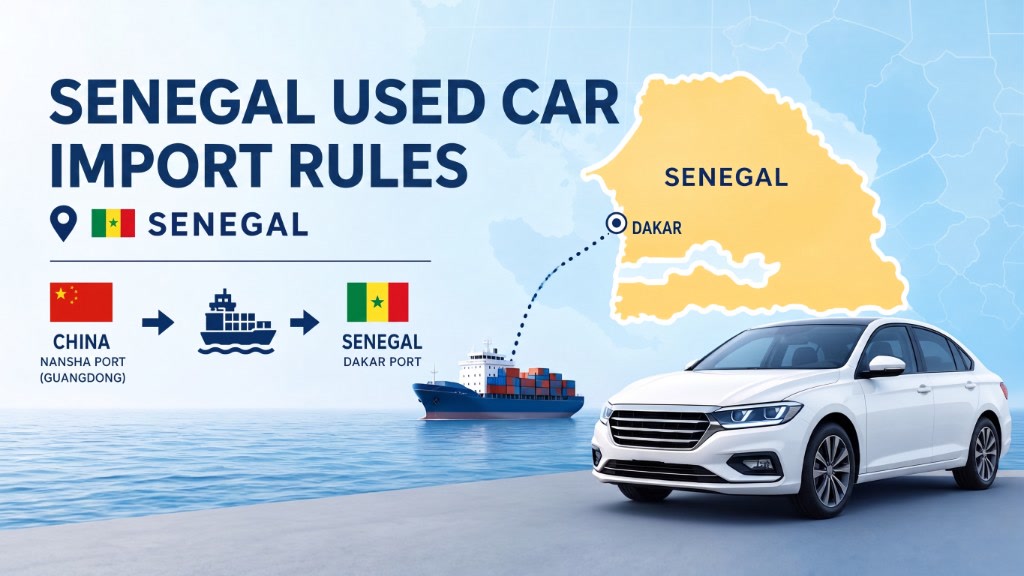
Once age and documents check out, the next hurdles are getting the numbers right and finishing every post-clearance step. Senegal applies UEMOA tariff rules: used passenger cars (HS 8703) face 20% customs duty; used LCVs (HS 8704, ≤ 3.5 t) face 10%; VAT is 18%. Customs often values vehicles against Argus/list prices—not whatever the invoice says.
This guide covers duties, FOB valuation, landed-cost examples, Dakar clearance, and registration. For eligibility, age limits, and documents, see the companion piece: Senegal Used Car Import Admission Guide (2026).
Key takeaways
Passenger cars: DD 20%; LCVs: DD 10%; TVA 18% (cascading); no separate UEMOA relief for EVs/hybrids at tariff level
Customs FOB is usually the higher of invoice price and Argus/list value
Vehicle clearance is only at Dakar Port Nord / Port Sud; after release you still need CMC, inspection, registration, and insurance
Example: CIF USD 9,400 sedan → roughly USD 4,166 in government customs charges (excludes registration tax and port fees)
Quick answer: Taxes and clearance essentials
Topic | 2026 essentials (as of 2026-08-28) |
|---|---|
Passenger car duty | HS 8703: DD 20% + RS/PCS/PCC + TVA 18% |
LCV duty | HS 8704 (≤ 3.5 t): DD 10%; other levies as for passenger cars |
New energy vehicles | HEV/PHEV/BEV: same 20% DD at UEMOA level (no published exemption) |
Valuation | Invoice vs Argus/list price → higher value wins |
Clearance ports | Dakar Port Nord, Dakar Port Sud |
Clearance ≠ road-legal | Still need CMC → réception → registration → mandatory insurance |
1. Duty rates: ICE, hybrid, and electric
Bottom line: used passenger cars carry 20% duty at UEMOA level; there is no automatic “EV exemption”.
Powertrain | HS code (example) | Duty | VAT | Notes |
|---|---|---|---|---|
Petrol | 8703.21 | 20% | 18% | Most common |
Diesel | 8703.31 | 20% | 18% | Same as petrol |
Hybrid (HEV) | 8703.40 | 20% | 18% | Cannot declare as pure EV |
Plug-in hybrid (PHEV) | 8703.60 / 8703.70 | 20% | 18% | Same as above |
Battery electric (BEV) | 8703.80 | 20% | 18% | No published UEMOA relief |
Light truck / pickup | 8704.21 (≤ 3.5 t) | 10% | 18% | Lower DD than passenger cars |
Claims that “EVs are duty-free” do not appear in the published tariff; ask your broker for written customs confirmation before final payment. Battery MSDS/UN38.3 is usually required by the carrier or freight forwarder, not always by customs itself.
2. How customs values your vehicle (FOB)
Bottom line: customs usually takes the higher of invoice price and Argus/list value.
Senegal Customs’ rules for determining vehicle FOB value (douanes.sn/ndn104) set out the following:
2.1 Models listed in Argus
Rule | Detail |
|---|---|
Invoice vs Argus | Take the higher value |
When Argus applies | A further 20% depreciation may be applied |
Argus is a French used-vehicle reference catalogue. Models not listed—common for China-built cars never sold in France—may be subject to assimilation (analogue valuation).
2.2 New models not yet in Argus
Take the higher of invoice price and new-vehicle export list price, then depreciate by time from first registration to clearance:
Time to clearance | Depreciation |
|---|---|
Within 1 month | 5% |
Within 2 months | 15% |
Within 3 months | 20% |
Beyond 3 months | Add 1% per additional month on top of the above |
Total depreciation is capped at 75% of new-vehicle list price.
2.3 Other cases
Situation | Treatment |
|---|---|
Delisted Argus models | Higher of invoice vs last Argus quote |
Accident-damaged units | Expert report may be required; customs is not bound by it |
Non-standard options | Options must be included in declared value |
Before shipping, send invoice, spec sheet, and registration proof to a Dakar broker for an FOB pre-check.
3. Which taxes apply — and how they stack
Taxes fall into two buckets: port clearance (customs) and registration (horsepower-based levy).
3.1 Clearance: used passenger cars (HS 8703)
Levy | Name | Rate | Base |
|---|---|---|---|
DD | Customs duty | 20% | CIF/CAF |
RS | Statistical levy | 1% | CIF/CAF |
PCS | Community solidarity levy | 0.8% | CIF/CAF |
PCC | ECOWAS community levy | 0.5% | CIF/CAF |
TVA | VAT | 18% | CIF + duty + levies above |
3.2 Clearance: used LCVs (HS 8704, ≤ 3.5 t)
Same logic as passenger cars, but DD is 10% (UEMOA TEC 8704.21.20.00).
Official cumulative-rate worksheets: douanes.sn/ndn103. Always rely on broker simulations and the customs assessment notice (Avis de liquidation).
3.3 Registration: circulation tax
Under CGI Article 524, registration tax is based on horsepower (cheval vapeur). Exact amounts appear on CMC and registration fee slips on the day you apply.
4. Landed-cost examples
The examples below cover government customs charges only—not registration tax, port charges, broker fees, inspection, or insurance.
Example 1: Used petrol sedan
Item | Amount (USD) |
|---|---|
FOB | 8,000 |
Ocean freight | 1,200 |
Insurance | 200 |
CIF | 9,400 |
Customs duty (DD)     = 9,400 × 20%   = 1,880
Statistical levy (RS) = 9,400 × 1%    =    94
Solidarity (PCS)      = 9,400 × 0.8%  =    75
Community (PCC)       = 9,400 × 0.5%  =    47
────────────────────────────────────────────
VAT base = 9,400 + 1,880 + 94 + 75 + 47 = 11,496
VAT (TVA) = 11,496 × 18%                = 2,069
────────────────────────────────────────────
Total customs charges ≈ USD 4,166
Example 2: Used BEV sedan (CIF USD 13,500)
Same rates as ICE, total roughly USD 5,982 (duties and levies USD 3,010 + TVA USD 2,972).
5. Clearance workflow: from loading to road-legal
Recommended sequence:
Step | Stage | Notes |
|---|---|---|
1 | Vehicle pre-check | See admission guide |
2 | Valuation pre-check | Invoice + full file → broker FOB estimate |
3 | Before loading | BSC, DPI if required; China→Dakar sea transit typically 30–45 days |
4 | Arrival declaration | File via GAINDE |
5 | Customs inspection & valuation | — |
6 | Pay and release | — |
7 | Apply for CMC | Certificat de Mise à la Consommation |
8 | Technical inspection | réception |
9 | Register & insure | Includes mandatory third-party liability cover |
Customs release ≠ you may drive. High-value shipments should go through a licensed broker (transitaire).
6. Registration, insurance, and plates
Item | Detail |
|---|---|
Authority | Land transport ministry / MITTA platform |
Core files | CMC + home-country registration proof + customs assessment |
Local registration card | Senegal issues its own carte grise—not the same document as the home-country card |
Mandatory insurance | Third-party liability before driving on public roads |
European stock | Usually submit original carte grise |
China-sourced stock | No registration original; confirm substitutes with broker and customs |
7. Common mistakes (taxes & clearance)
Mistake | Reality |
|---|---|
Low invoice = low tax | Customs uses the higher of Argus/list and invoice |
EVs are automatically duty-free | No published UEMOA exemption—confirm in writing |
Declaring a hybrid as pure EV | Different HS codes; misclassification risks delays and penalties |
Driving right after clearance | Still need CMC, inspection, registration, insurance |
LCV duty at 20% | HS 8704 DD is 10% |
8. Official sources (taxes & clearance)
Source | Description | Link |
|---|---|---|
UEMOA External Tariff 2022 | Rate schedule | |
Vehicle FOB valuation rules | Customs | |
Cumulative rate worksheets | Customs | |
Vehicle clearance guide | Ministry of Finance | |
Highway Code 2022-04 | Inspection & registration |
9. Key French terms (taxes & clearance)
French / abbreviation | Meaning |
|---|---|
FOB | Free on board (export price) |
CIF / CAF | Cost, insurance & freight (landed value base) |
TVA | Value-added tax (not “VTA”) |
DD | Import customs duty |
Argus | French used-vehicle reference catalogue |
CMC | Certificat de Mise à la Consommation (consumption release certificate) |
réception | Technical vehicle inspection |
transitaire | Licensed customs broker |
DGD | Senegal Customs (Direction générale des Douanes) |